A real estate marketing plan is a one-page decision about who you serve, where you serve them, how people find you, and how you follow up. Mine has eight parts and runs in 90-day cycles. It starts with where your last ten clients came from, because your plan should feed what already works before it chases anything new.
Most agents don't have a marketing problem. They have a "nobody decided anything" problem.
I see it every time I start with a new client. There's a Canva folder, a half-finished website, a Google profile last touched in 2023, and a vague feeling that they should be posting more. No plan. Just a pile of good intentions and a monthly bill for tools nobody opens.
So here's the plan I actually build. Same eight parts for a solo agent in Wake Forest, a team in Mooresville, or a loan officer in Cary. The template is below. Steal it.
Why Most Real Estate Marketing Plans Fail
Real estate marketing plans fail because they start with tactics instead of with how clients already find the agent. "Post three times a week" isn't a plan. It's a chore with no reason attached.
Think about how you treat referrals. You know exactly who sends you business. You take that person to lunch. You don't spend your Saturday cold-calling strangers while your best referral partner forgets your name.
Your marketing works the same way. Google, AI search, and your sphere are all referral sources now. The plan's job is to figure out which ones already send you people, then make sure you look solid when those people check you out.
What does a real estate marketing plan actually need?
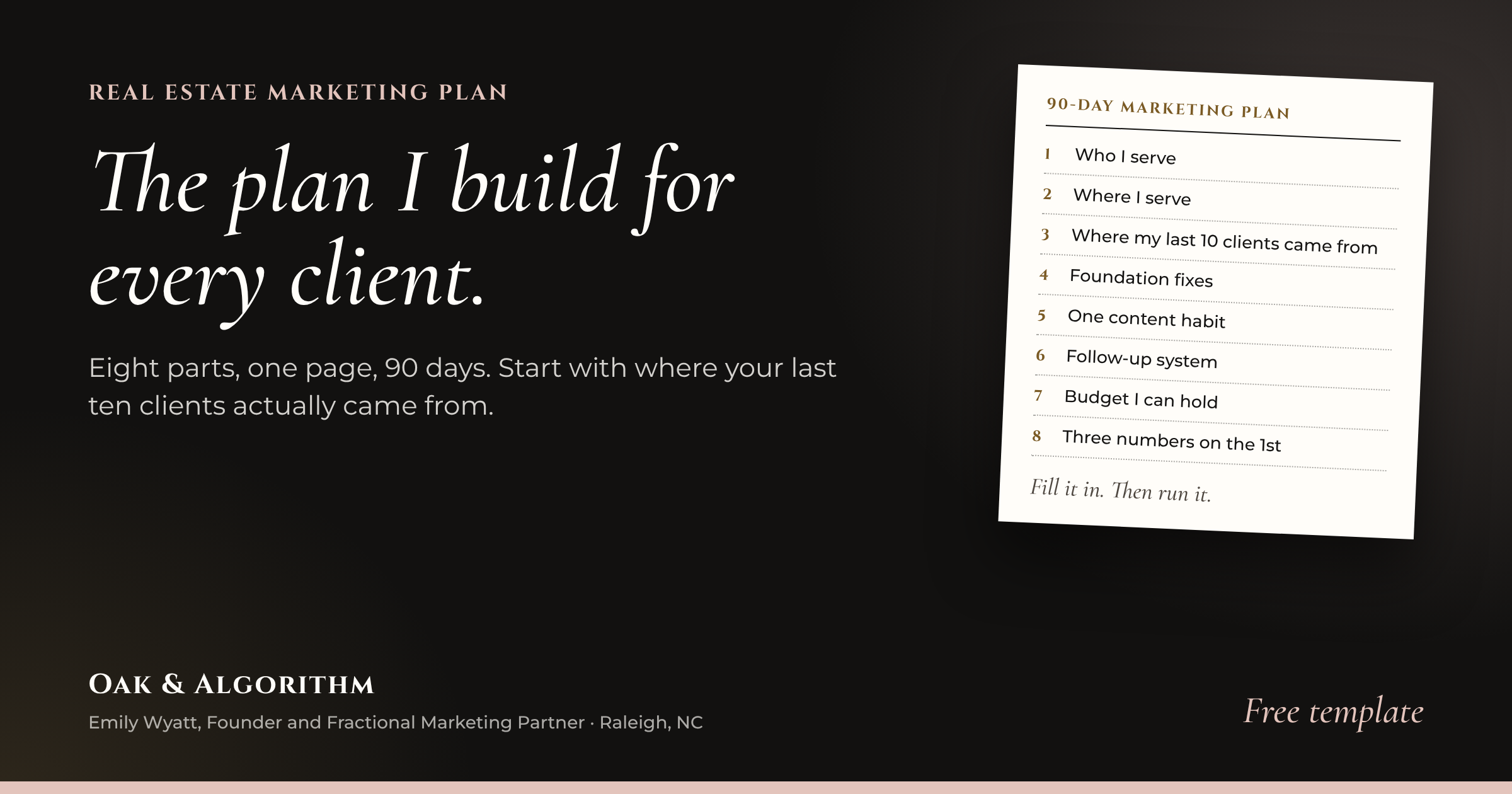
Eight decisions, written down, on one page. Who, where, where clients come from, your foundation, one content habit, follow-up, budget, and three numbers. If a tactic doesn't serve one of those eight, it waits.
The 8-Part Real Estate Marketing Plan Template
The Oak & Algorithm marketing plan template fits on one page and answers eight questions in order. Fill it in top to bottom. Don't skip ahead to the fun part. The fun part only works if the boring part is done.
One sentence. "First-time buyers relocating to Raleigh from the Northeast" beats "buyers and sellers."
One home market plus the three to five towns or neighborhoods you want to be known for.
Count them: sphere, past client, Google, AI search, social, open house, portal, other.
What would a stranger see if they looked me up today? Google Business Profile, reviews, website, headshot, bio.
One question my clients ask, answered once a week, in one place first. Then cut it up for everywhere else.
What happens in the first five minutes, the first week, and the first year after someone raises their hand?
A monthly number I can hold for twelve months. Split into things I keep and things I rent.
Pick three. Calls and website clicks from Google, new reviews, and conversations started is a good default.
Print this page and the template prints clean. Or copy it into a doc and fill it in during your next slow afternoon.
1. Who do you serve?
Pick the client you'd clone if you could. Not forever, just for this 90 days. A narrow answer gives Google and AI tools something specific to match you to. "Raleigh Realtor" matches everybody. "Raleigh Realtor for families relocating from New Jersey" matches you.
2. Where do you serve?
Name your home market and the handful of places you want to own. Then check that the same list shows up on your Google Business Profile, your website, and your bio. When those three disagree, Google and AI tools hedge, and a hedge usually means somebody else gets named.
3. Where did your last 10 clients come from?
This is the part everyone skips, and it's the most useful part. Pull your last ten closings and write the honest source next to each one. You'll usually find one or two channels doing most of the work and three or four you're paying for out of habit.
When I did this for my own business, the answer surprised even me. 17 of my 19 clients found me through AI search and 2 found me through Google. Zero came from referrals. If I'd built my plan around networking events, I'd have built it around nothing.
4. What would a stranger see if they looked you up?
Every referral gets checked. Your friend recommends you, and the buyer googles you before they ever call. If they find a thin profile, three reviews from 2021, and a website that looks like every other agent's, the referral dies quietly and you never hear about it.
Fix the foundation before you buy a single ad. That means a complete Google Business Profile for Realtors, a steady review habit, and a website that explains who you help and where. If you're not sure which of those is weakest, the Google Visibility Audit tells you in plain English.
5. What is your one content habit?
One question a week. That's it. Take a question a client asked you this week, answer it fully on your website, then turn that answer into a Google post, a short video, and a social caption. One idea, four places.
Weekly answers are how you show up when someone asks ChatGPT or Google's AI who knows a market. AI tools recommend agents they can find clear, specific answers from. If you want to see how that works, read how Realtors get found in AI search.
6. What happens after someone raises their hand?
Most marketing plans end at the lead. Mine doesn't, because that's where most of the money leaks out. Write down what happens in the first five minutes, the first week, and the first year. If the honest answer is "I text them when I remember," that's your biggest opportunity, and it's cheaper to fix than any ad. A real real estate CRM follow-up system keeps people warm while you're busy closing.
7. What is your budget?
Pick a monthly number you can hold for a year. Twelve steady months beats three loud ones every time. Then split it into two buckets: things you keep, like your website, your Google profile, and your content, and things you rent, like portal leads and paid ads. Keep the first bucket full before you feed the second. I break down the keep-versus-rent math in the best advertising for Realtors.
8. Which three numbers will you check every month?
Three numbers, checked on the first of every month. More than three and you'll stop looking. I like calls and website clicks from your Google Business Profile, new reviews, and new conversations started. If those three go up, the rest usually follows.
How to Run the Plan in 90-Day Cycles
A 90-day cycle is long enough to see real movement and short enough that you can't hide from what isn't working. A year-long plan is a wish. A 90-day plan is a commitment.
| Month | Focus | What gets done |
|---|---|---|
| Month 1 | Foundation | Fix the Google Business Profile, start the review habit, tighten the website pages for who you serve and where, set up follow-up. |
| Month 2 | Publish | One answered question a week on your site, cut into a Google post, a short video, and a social caption. |
| Month 3 | Measure and adjust | Check your three numbers, look at which questions brought people in, and decide what to keep, cut, or double. |
How long does a real estate marketing plan take to work?
Expect early signals in about 90 days and steady results around six months. Google profile fixes and reviews move first. Website content and AI visibility build slower, then keep working long after you've moved on to the next cycle. That's why I sell the Visibility + Authority Foundation as a six-month engagement and not a one-month sprint.
Real Estate Marketing Plan Mistakes I See Every Week
The most expensive real estate marketing mistake is paying for attention you can't keep. The others are close behind.
- Copying a big team's plan. A 40-agent team can afford to be everywhere. You can't, and you don't need to be.
- Posting without a home base. Social posts disappear in a day. An answer on your website keeps getting found for years.
- Treating every platform the same. The same caption pasted five places reads like nobody's home.
- Skipping follow-up. You paid to start the conversation. Finish it.
- Never checking the numbers. If you don't look on the first of the month, you're guessing with your money.
Want it done for you? This template is the same one I use in client strategy sessions. If you'd rather hand it off, see how I work with agents, teams, lenders, and builders, or compare real estate marketing companies in Raleigh before you decide who to hire.
Real Estate Marketing Plan FAQ
What should a real estate marketing plan include?
A real estate marketing plan should include who you serve, the area you serve, where your last ten clients came from, the foundation you need to fix first, one content habit, a follow-up system, a budget, and three numbers you check every month. Anything past that is decoration until those eight pieces are in place.
How do I write a real estate marketing plan?
Write a real estate marketing plan by starting with your last ten closings, not with a list of tactics. Find where those clients came from, fix whatever a stranger would see when they look you up, pick one weekly content habit you can keep, and set three numbers to review on the first of every month.
How much should a real estate agent spend on marketing?
A real estate agent should set a marketing budget they can hold for twelve months without flinching, because consistency matters more than size. Spend on the things you keep, like your Google Business Profile, your website, and your follow-up system, before you spend on ads that stop working the day you stop paying.
How long does a real estate marketing plan take to work?
A real estate marketing plan usually takes about 90 days to show early signals and six months to show steady results. Google profile fixes and review habits move first. Website content and AI search visibility build more slowly, then keep paying off long after the work is done.
Do new real estate agents need a marketing plan?
Yes, new real estate agents need a marketing plan more than anyone, because they have no past clients to lean on yet. A new agent's plan should be simple: one service area, a complete Google Business Profile, a review habit from the first closing, and one helpful post a week.
What is the best marketing strategy for real estate agents?
The best marketing strategy for real estate agents is to be easy to find and easy to trust when someone looks you up. That means a complete Google Business Profile, steady reviews, and a website that answers the questions buyers and sellers in your area actually ask, so Google and AI tools can recommend you.
Should my real estate marketing plan include AI search?
Yes, a real estate marketing plan should include AI search, because buyers and sellers now ask ChatGPT and Google's AI answers who to hire. You show up there the same way you show up anywhere: clear pages about who you help and where, consistent details across the web, and reviews that say what you do well.
Not sure where your plan should start?
The audit looks at your Google profile, your website, and how AI tools describe you, then tells you which part of this plan to fix first.
Get the Visibility Audit Book a Strategy Call